what to spray on cut off shrubs to prevent growth
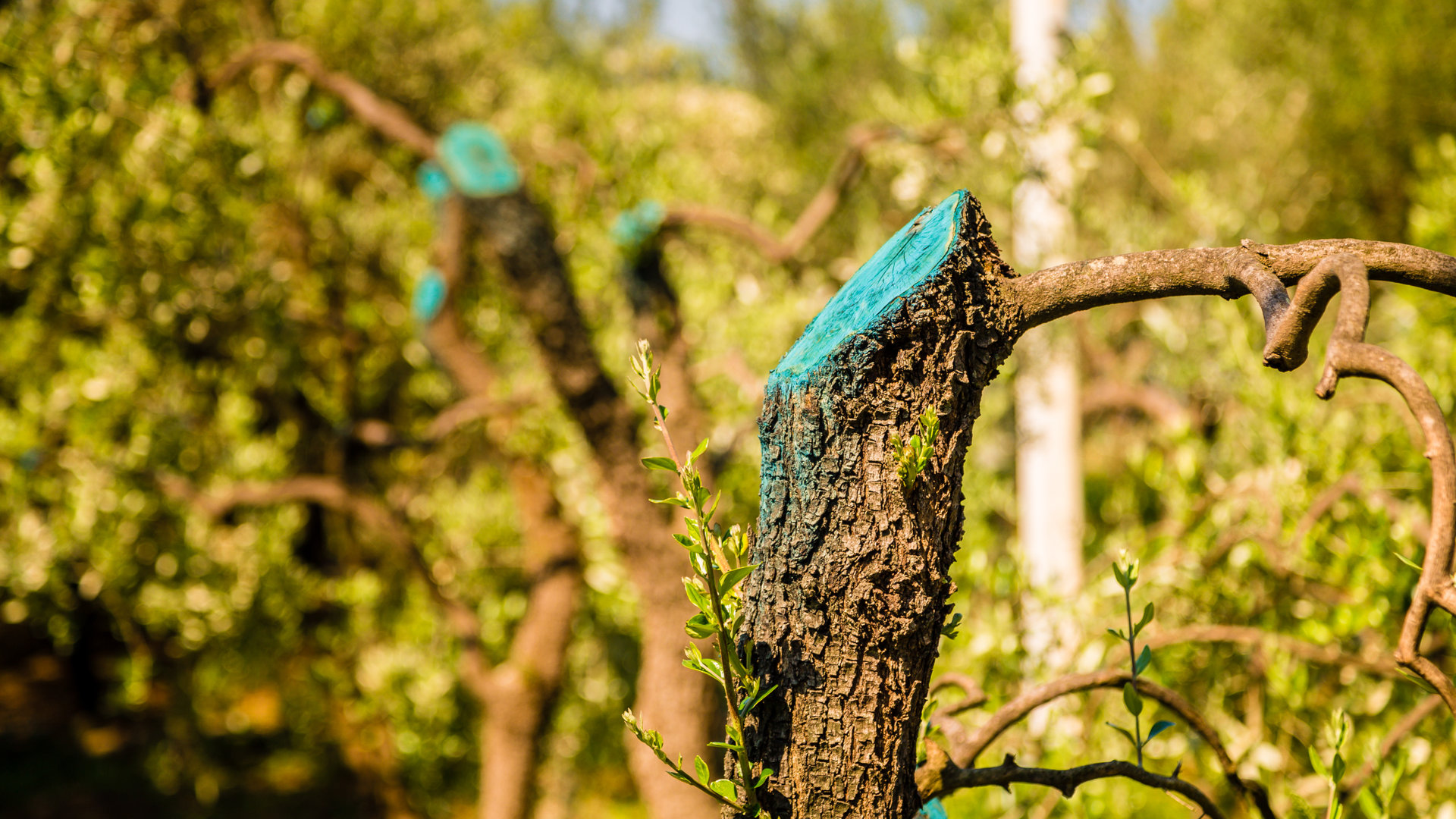
For a long fourth dimension, it was common practice to use a pruning sealer when trimming copse — a seemingly common-sense exercise recommended past trained arborists and nursery workers akin. Generations of homeowners grew upwardly assertive that painting on an awarding of pruning sealer on trees limbs/branches was an integral part of "safe" tree pruning.
No longer. "Current best practices no longer recommend applying sealants to tree wounds," says Karl Flocke, a woodland ecologist who works for the Texas A&M Wood Service.
Then allow's talk nigh why it'south at present considered a gardening myth and how yesterday's tree bandage became today'southward bad practise.
What is tree pruning sealer?
A tree pruning sealer is a peculiarly designed waterproof product that is applied, or "painted," onto the exposed cut on a limb or branch after pruning. For many, many years — and still to this 24-hour interval in some cases — people were told by an arborist that tree wound had to be covered with a sealant.
A tree pruning sealer is a cast of sorts meant to embrace the wound. Their packaging claims to aid in the healing of pruning cuts, minimize sap loss, and protect trees from decay, insects, and fungi.
It was an easy DIY projection, the product was (and still is) in stock at all garden and big box stores, then it became ingrained as a habit for homeowners.
While good in theory, scientific research conducted by Alex Shigo of the U.S. Wood Service in the late 1970s explained that pruning cuts should not be painted. Rather, the tree should be left to heal through its own devices later yous prune information technology. He emphasized the importance of following proper pruning practices. Let a fresh cut heal naturally instead of covering it with a wound dressing, he urged.
Why tree sealant fell from grace
Subsequently studies confirmed Shigo's work. Today's arborists are trained to consider sealers a bad practice because they make it harder for trees to recover subsequently pruning.
It's important to understand that trees don't really heal later on they have been damaged. According to the University of Arizona Cooperative Extension, they instead isolate harm through a process chosen compartmentalization. Callus tissue develops at the border of the wound and gradually grows in toward the heart. When copse are pruned correctly this new growth eventually covers the pruning wounds, protecting the damaged trees.
These sealant products are typically petroleum-based, although some may contain cobblestone — and actually trap moisture inside the tree wound, which may encourage more problems instead of preventing them. Some products exist touting natural ingredients such as collagen, pectin, or aloe vera. Unfortunately, there isn't whatever scientific proof that they benefit the tree, either.
The petroleum and asphalt-based wound dressings are known to:
- seal in moisture and decay;
- sometimes serve as a food source for pathogens;
- prevent wound wood from forming;
- inhibit compartmentalization;
- somewhen crack, exposing the tree to pathogens.
Liked by neither tree nor homo
They're no fun for humans, either.
Thanks to their volatile combination of cobblestone and solvent, according to the safety data canvass for one popular product, they:
- Contain gas nether pressure level and may explode if heated.
- Cause serious eye irritation.
- Cause skin irritation.
- May cause genetic defects.
- May crusade cancer.
Vesture pare and eye protection, the label advises, and store it in a cool, well-ventilated place.
So afterward learning those tidbits, it'south a bit easier to run across why y'all should stop using pruning sealer on your copse.
Should yous seal pruned limbs at all?
The curt respond to this is no! You should not use pruning pigment to seal pruned limbs at all. They are meliorate left to undergo natural healing through their ain found defense mechanisms.
Plus, why would you want to put a product on your tree that can also be used to seal and waterproof rain gutters, roof flashings, wooden planters, the underside of a lawn mower deck, or fifty-fifty pocket-sized sections of cobblestone driveways? If something claims to exist constructive for these other outdoor uses, don't put it on a living tree. In my opinion, it'due south amend to leave the tree be and so it can "fix" itself.
Instead of sealing pruning wounds it'southward better to implement prevention. You can minimize problems that may stalk from pruning by following these tips:
- Properly sterilize all pruning tools with a 70% isopropyl alcohol solution earlier and later using them. That applies regardless of the fourth dimension of year you lot are pruning, or the type of tree you are working on.
- Control the spread of disease by properly disposing of all problematic limbs/branches after pruning. Employ only use disease-free mulches or compost.
- Make clean, smooth cuts making sure to not leave stubs but keep the branch collar intact.
- Prune copse at the proper time, preferably in the bound when they are still dormant and haven't started forming leaves. This makes them less susceptible to infestations or infections.
The Exception: Oak Trees
Oak trees in about 24 states, from the center Eastern states south through Texas, can suffer from oak wilt. The harm done tin be both devastating and irreversible. The fungus that causes the disease spreads from tree to tree, carried by Nitidulid beetles attracted to the scent of the tree's sap. The insects will then move to another tree, laden with oak wilt fungus spores, and spread the disease. So quickly covering whatever pruned branches will cover that fresh-sap smell before the beetles come a-running.
"Most forms of paint work equally well, and there is no need for specialized rubberized or petroleum sealants," says Texas A&G'due south Flocke. He's stationed in Austin, Texas, where oak tree wilt is such a business organization that pruning oaks is discouraged from February through June. "The wound pigment is only necessary for the first two to four days after the cut has been fabricated," Flocke says, "so at that place is no need to reapply pigment or to get out and paint old wounds."
How to remove pruning sealer
I'thou sure you're at present request yourself if using a pruning sealer has caused irreparable damage to your copse. You may as well wonder if you should consider removing information technology. This isn't so easy to answer and surprisingly in that location isn't much discussion about information technology online.
I recommend if your trees' pruning cuts had sealer practical to them, remove information technology if possible. Due to the chemic composition of the sealer, y'all can't simply skin it off and throw it away, unfortunately.
The best manner to remove pruning sealer would exist to make a new pruning cut on the branch. Remove the paint, and create a new, open up wound. A new pruning cut wouldn't need to be made much below the old one. Perhaps a quarter to a half of an inch is good if there's plenty wood to do that. Make sure it'due south a clean, straight cutting and your tools are sterilized.
This new wound volition trigger the tree to brainstorm the procedure of compartmentalization, forming a new callus to protect the wound naturally.
Story originally published Nov. 12, 2019

Amanda Shiffler
Most comfortable with soil under her fingernails, Amanda has an enthusiasm for gardening, agriculture, and all things plant-related. With a master'southward degree in agriculture and more than a decade of experience gardening and tending to her lawn, she combines her found knowledge and knack for writing to share what she knows and loves.
Source: https://www.lawnstarter.com/blog/tree-care/tree-pruning-sealer-bad-idea/
Belum ada Komentar untuk "what to spray on cut off shrubs to prevent growth"
Posting Komentar